
When execution costs nothing, thinking is what designers have left.
Created on
November 19, 2026
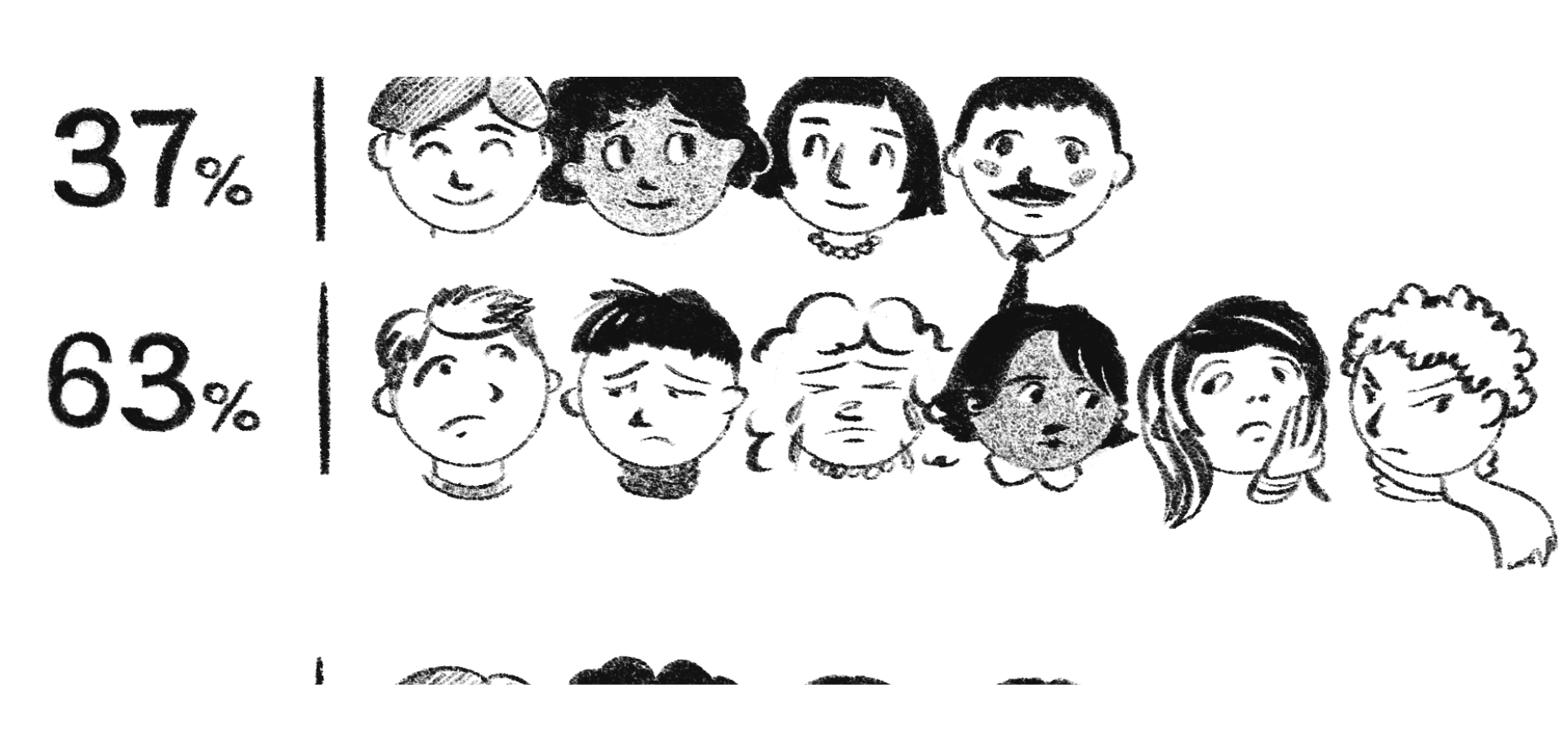
Designers are among the most overwhelmed roles in tech right now. According to the second annual industry sentiment survey, published this summer by Noam Segal and Lenny Rachitsky, who surveyed around six thousand people across different roles, 63% of designers feel overwhelmed by the pace of change, 61% feel tired, and 61% say they’re expected to do more while compensation remains flat. Together with researchers, designers are also the least willing to recommend their profession to anyone starting out.
The main finding of that survey, though, isn't about decline. It's about a split. The industry has divided roughly in half, with one half feeling energized and amplified by AI, and the other experiencing burnout, falling optimism, and anxiety about the future. And if you follow how the industry has changed over the years, you can see there's no contradiction here.
Design has always been a profession without clear boundaries. What a designer was supposed to know was defined by context, not by a standard, even though most job requirements and designer case studies look as if that standard exists and applies everywhere. And this inconsistency in expectations is probably the only professional constant in the entire history of the field.
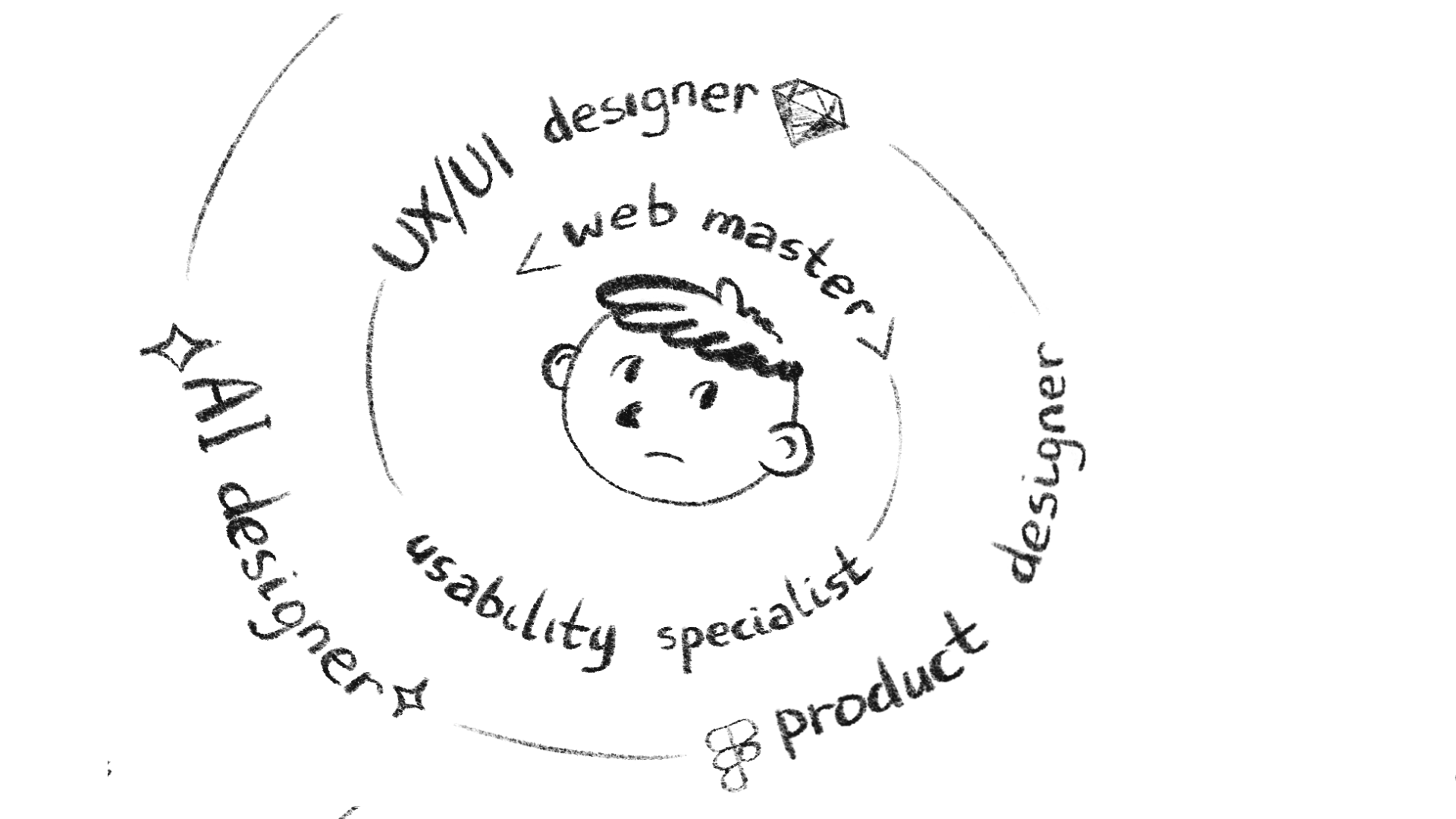
At the end of the last century, when UX/UI or product design existed only inside a few companies and weren't common terms yet, everyone used the word webmaster. That was a single-person category that did everything, including website markup, graphics, infrastructure, and content, with no split into categories. Sounds familiar, doesn't it?
The web designer role that replaced it narrowed the focus down to visuals and marketing, treating "how do we make this site beautiful and make it sell" as the main job. Code came up less and less, and the conversation shifted toward visuals and communication.
UX/UI, and later Product Designers, formalized the discipline. It got its own language, such as CJMs, personas, user flows, research, etc. And inside that role, a lighter version of it was born, the one that gave design its reputation as an easy entry point into tech. "Learned how to draw pretty screens?" Congratulations, you're a Product Designer now. And for quite a long time, a designer was defined precisely by the ability to create elegant UIs.
The result of all these transformations is that we ended up with a whole zoo of roles that mostly do the same job, and a completely different set of expectations from people with the same title and the same job description. And while large corporations with larger budgets were often looking for narrow specialists to handle specific tasks, startups, scale-ups, and agencies increasingly went for the so-called Swiss army knife designers that you could brief on a problem in general terms and be confident they'd solve it at the highest possible level.
Today, when everyone can do everything, engineers do design, product managers prototype and test hypotheses themselves, business owners put together and launch a site in one evening. And designers finally got the thing they'd been missing for so long. They were no longer just producing an enormous number of artifacts on boards and drawing beautiful pictures in Figma that may never ship. They were finally building full end-to-end products, which could be tested with users far more effectively before handing anything over to engineering.
So now we see two things at once. On one side, people for whom design was always about making visual interfaces find themselves in a reality where their skills are less in demand. On the other, UX/UI and Product Design are being pushed aside by new terms like Builder, Design Engineer, and plenty of others that go beyond the familiar tools like Miro or Figma. We also see it in how client requests have changed. People come to designers less often for a beautiful interface, and more often for product strategy.
This is far from the first transformation, and none of the previous iterations went smoothly or unnoticed. They were messy. This one will be too. Some people find it difficult to manage or adapt, dropping out of the profession as it previously existed. For some, it costs a career, for others, an entire business. So, saying that design "just evolved" and that everything only gets better would be dishonest.
But in this new paradigm, where everyone can do everything, we have a huge advantage over previous shifts. We've always worked at the intersection of excellent craft and product vision. Working between business and engineering stakeholders, designers had to understand the product deeply enough to know whether we were building the right thing, and whether anything needed to be built at all. We had to raise product quality and perception through UX/UI, which is heavily tied to how a person thinks, what they feel, and what mood they're in when using the product. And on top of that, designers had to understand engineering well enough that the next small improvement wouldn't disrupt the implementation stage.
When the market is this inconsistent about what it asks for from designers, and the tools keep changing faster than the standards can settle, the only thing that remains valuable on top of any specific skill-set is the product thinking and the ability to adapt. Skills are a variable, and they've always been contextual. Mindset and the way we operate are what endure through these transformations.
Junior designers deserve a separate mention here. The tasks people used to grow up doing are tasks AI can now do much faster and at a much higher level, which is why companies mostly look for senior designers who can pick up AI quickly and do the work of ten people. The good news is that the market isn't unanimous on this, and many leading companies continue showing serious interest in design interns and early career designers with limited experience.
Jenny Wen, Head of Design at Cursor (previously Figma and Anthropic), has discussed looking for fast learners without the legacy of ingrained habits and processes in their behaviors, instead of the ready-made seniors most of the market is demanding.
"Given how much the roles are changing and what we're expected to do is changing, I think having somebody who almost has a blank slate and is a really quick learner and is really eager to learn new tactics … and doesn't have all these baked-in processes and rituals in their mind, that's super valuable."
Jenny Wen, Head of Design at Cursor
She isn't saying that design has changed completely; she still prototypes and creates mockups every day herself. She's saying that the process we all got used to stopped being dogma a long time ago, and that it started dying before AI. Engineers with their AI agents just accelerated this change. In this new reality, people without preconceptions, who haven't had time to get set in their ways about what's right and what's wrong, turn out to be interesting hires.
The hardest parts of design are rarely tethered to generating form. The real value of design originates from understanding the problem well enough to decide what should exist in the first place, and in what shape and function. AI is great at answering "how should this work?" and almost never at "does this need to exist?" or "what makes it differentiated?"
No matter how fast AI is developing, it's still linear. AI produces one coherent answer at a time, based on prior data about what a good solution looked like. The key phrasing there is “looked like,” past tense. The value of a designer is being able to forecast the future, to make eight or ten completely different concepts, evaluate them side-by-side, and assemble one complete functional, future-ready solution from those ideas. AI agents can't do that on their own yet, and without someone strong steering them, the result often falls short. That's exactly why we're seeing an enormous number of products that look merely fine, usable, yet quite often don't solve a single one of the problems they're intended for.
Products are being built so fast now that the only thing faster is the churn inside those products. Designers are trying to get faster at their craft too, of course, but in our case, the point of speed is to get feedback earlier and improve, not to ship something raw and untested.
That acceleration is a good explanation for why designers are experiencing discontent. Engineering sped up tenfold and more; design didn't, and against that background, designers feel like they're falling behind. Not because designers are worse or slower than engineers. Rather, it's because the design process is fundamentally different by nature. You try something, it turns out badly; you try again and collect feedback; you fix it again, and around it goes. Design is heavily tied to feedback and interaction, and if you hand that design process over to AI agents, what you get is not at all what a living person, the one you're building it for, actually needs. Speed and quality in design aren't just different metrics; in fact, they quite often work directly against each other.
The roughly fifty-fifty split we started with isn't an accident. It seems to run parallel with the whole history of how design developed and evolved. The designers holding vigilantly on to a specific set of skills, or to the version of the profession they once succeeded in, are having a harder time. The designers who focus on evolving their thinking and continually adapt, exploring new approaches and processes that leverage AI vs. resist it, without fixating on the past, are finding new opportunities.
Historically, because of how software development processes were constructed, there were typically fewer designers than engineers represented. Now, engineering has sped up, and the bottleneck has moved. Before long, we may likely see the opposite trend, with several designers per engineer, because creativity and originality will become increasingly scarce in a world where execution costs nothing and all product designs bear a striking resemblance to each other.
Design is where differentiation will become obvious.
"I strongly believe this is the best time in history to be a designer."
Ian Silber, former Head of Product Design at OpenAI
According to the internet, design has died a few dozen times in recent years, and yet it hasn't died once. And it won't. The tools we use today can die and the process we follow can die, but the foundational core that defines design — thinking, creativity, and human ingenuity — will remain what differentiates, and will be the reason demand for designers continues growing.